
Patan Durbar Square: The City of Hidden Courtyards and Living Craft
The master metalworkers, quiet bahals, and golden shrines of ancient Lalitpur.

3) Patan Durbar square: The City of Hidden Courtyards and Living Craft
There is something different about Patan. Kathmandu can feel restless. Bhaktapur feels as though it has paused to remember another time. But Patan feels busy creating quietly, patiently, almost unnoticed.
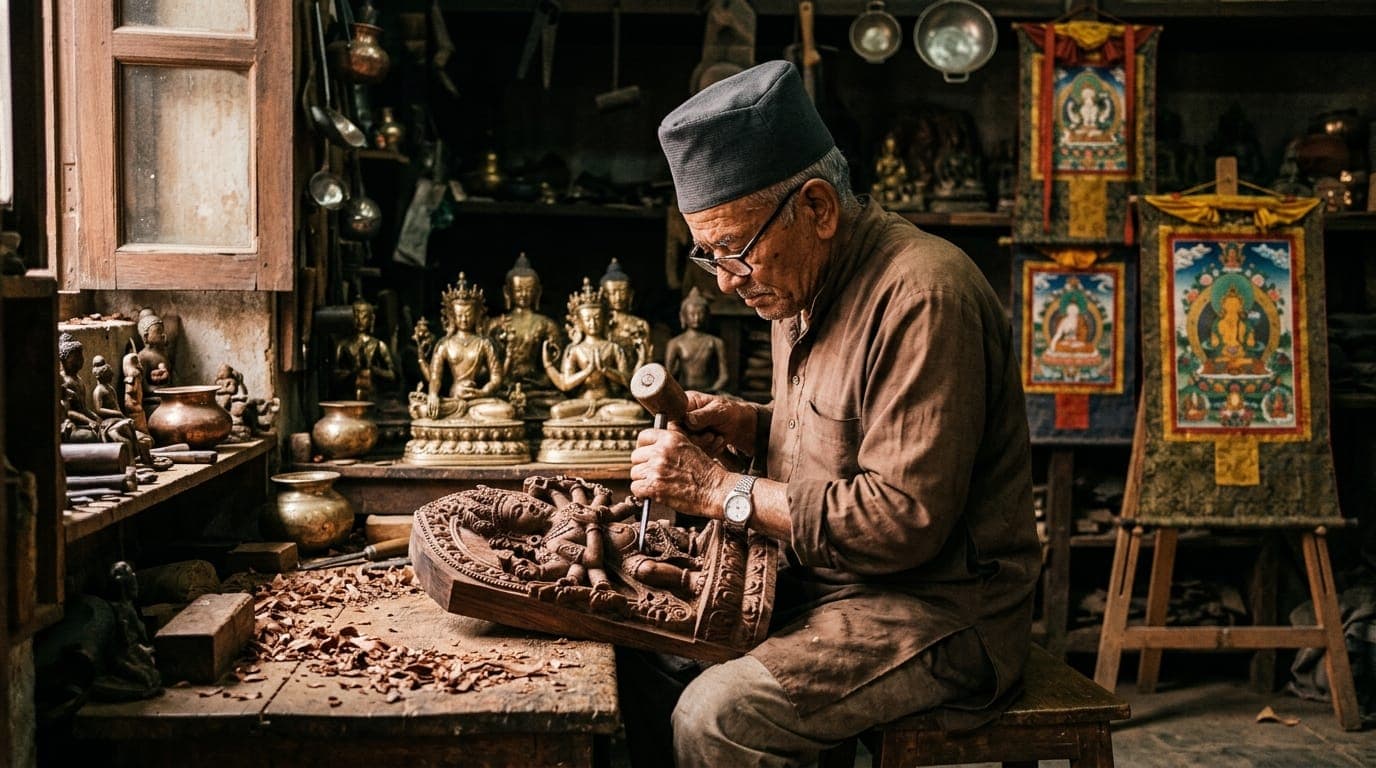
Walk away from the main road and the city begins to reveal itself. A small doorway opens into a courtyard. A shrine appears between two old houses. Somewhere nearby, metal is being hammered into shape. A craftsman sits with the concentration of someone who has done the same work for decades.
A City Built by Makers
Patan is often introduced through its temples and Durbar Square. But if you only look at its monuments, you miss what makes the city special.
Patan is a city of makers.
For generations, artisans here have worked with metal, wood, stone and clay. Walk through the older neighbourhoods and you may hear the unmistakable rhythm of a hammer striking metal.
The techniques are ancient, but the work is not simply preserved behind glass.
It is still being done.
That is what makes Patan different.
In Kathmandu, you can encounter history everywhere. In Bhaktapur, you can feel history surrounding everyday life. In Patan, you can sometimes watch history being made by hand.
Patan Durbar Square: More Than a Royal Palace
Patan Durbar Square was once the royal centre of the Malla kingdom, but standing there today, it is difficult to think of it simply as a palace complex.
The square feels more like an open museum of Newar civilization except that the museum is still alive.
The Krishna Mandir, with its distinctive stone architecture, stands at the heart of the square. The courtyards lead you deeper into the old palace complex, where carved windows, bronze details and traditional architectural forms reveal the extraordinary skill of the people who built them.
And then there are places such as Sundari Chowk and Tusha Hiti, where water, architecture and craftsmanship come together.The remarkable thing is not simply that these structures survived.It is that their ideas still belong to the city.
Where Hinduism and Buddhism Meet
Perhaps nowhere is Patan's character clearer than in its religious architecture.
You do not have to travel far to move between Hindu temples and Buddhist monasteries.
A few steps can take you from one tradition into another.
The Golden Temple, or Hiranya Varna Mahavihar, leads you into one of Patan's historic Buddhist courtyards. Elsewhere, temples and bahals continue to exist within the same urban fabric.
This is not simply a story of two religions existing side by side.
For centuries, the traditions have influenced one another, shared artistic traditions and become part of the same community life.
Patan teaches you that heritage does not always have neat boundaries.
Sometimes, it grows through exchange.
Leave the Main Square
This is where I would encourage anyone visiting Patan to do something simple:
Leave the main square. You may find Mahaboudha, an extraordinary terracotta Buddhist monument covered with countless Buddha images.
You may discover Rudra Varna Mahavihar, with its remarkable collection of religious art.
You may come across an old bahal where people are still gathering, a small shrine tucked between houses, or a traditional water spout that once formed part of the city's sophisticated water system.
These are the moments when Patan becomes interesting.
Because the city does not always announce its treasures.
You have to look for them.
A City That Understands Water
Patan's old water systems reveal another side of its intelligence.
Places such as Manga Hiti and Kumbheshwar remind us that these cities were not built only around temples and palaces.
They were designed around life.
Water had to reach communities. People needed gathering places. Religious spaces, homes, courtyards, markets and public infrastructure had to function together.
The old city was not a collection of beautiful buildings.
It was an urban system. And perhaps that is one of the most interesting things to discover while walking through Patan: behind the beauty is a practical understanding of how a community survives.
The Real Museum Is the Workshop
Eventually, you begin to understand something.
Patan's greatest museum may not be a museum at all.
It may be the workshop of an artisan.
A piece of metal slowly becomes a deity. A block of wood becomes a window. Clay becomes an architectural detail. A traditional technique passes quietly from one generation to another.
The city's heritage survives because someone still knows how to make it.
That is why Patan feels different from Kathmandu and Bhaktapur.
Kathmandu tells you about a city shaped by power, trade and constant change.
Bhaktapur invites you into a city that seems determined to remember.
Patan introduces you to the people who know how to create.
And perhaps that is the best way to explore Patan—not by rushing from one monument to another, but by slowing down enough to notice the hands, sounds, courtyards and traditions that continue to give the city its identity.
“Patan is not simply a city where ancient things remain.It is a city where ancient knowledge still has work to do.”
— Sakar's Journal
Sakar
Responsible Tour Director & Cultural Guide
Born in Nepal with deep roots in Himalayan heritage and community-based hospitality. As Responsible Tour Director, Sakar guides curious international travelers beyond mass tourism, facilitating authentic human connections, spiritual stillness, and sustainable village livelihoods.
Create Your Own Himalayan Story with Sakar
Explore the quiet valleys, sacred spaces, and living heritage described in this journal.
More Stories From Sakar's Journal

A Morning Inside a Nepali Village Home: Food, Hearth & Stories
The kitchen in a traditional Nepali home is the sacred center of family life. Step inside the fragrant world of woodfire cooking and genuine mountain hospitality.

Matthew and heena
Matthew had just navigated the treacherous, mud-caked terrain of flood-affected Dhading, dodging landslides and wading through swollen streams, but nothing prepared him for the intense salon operat...

Threading Seven Decades: Altan Baje's Journey from Turkey to The Looms of Nepal
the powerful, reflective journey of Altan Baje, a 70-year-old Turkish fashion industry veteran who built a decades-long career within the high-stakes supply chain and management world of global fas...