
Patan Durbar Square: The City of Hidden Courtyards and Living Craft
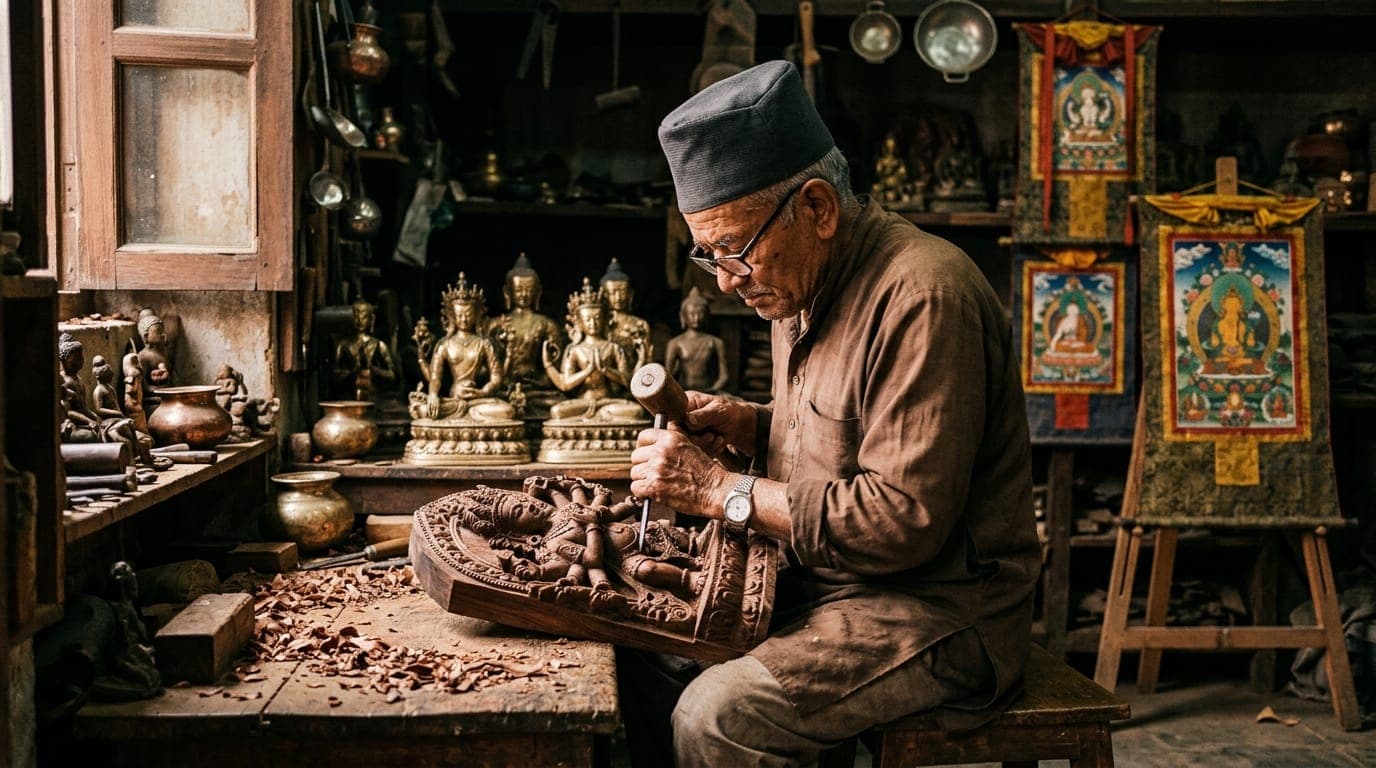
Patan is a city of makers. In Kathmandu, you encounter history everywhere. In Bhaktapur, you feel history surrounding everyday life. In Patan, you can watch history being made by hand.
Stepping Past the Tourist Facade
There is something different about Patan. Kathmandu can feel restless. Bhaktapur feels as though it has paused to remember another time. But Patan feels busy creating—quietly, patiently, almost unnoticed. Walk away from the main road and the city begins to reveal itself: a small doorway opens into a courtyard; a shrine appears between two old houses; somewhere nearby, metal is being hammered into shape. A craftsman sits with the concentration of someone who has done the same work for decades.
Patan is often introduced through its temples and Durbar Square. But if you only look at its monuments, you miss what makes the city special: Patan is a city of makers. For generations, artisans here have worked with metal, wood, stone, and clay. Walk through the older neighbourhoods and you hear the unmistakable rhythm of a hammer striking metal. The techniques are ancient, but the work is not preserved behind glass: it is still being done.
Patan Durbar Square was once the royal centre of the Malla kingdom, but standing there today, it is difficult to think of it simply as a palace complex. The square feels more like an open museum of Newar civilization—except that the museum is still alive. The Krishna Mandir, with its distinctive stone architecture, stands at the heart of the square. The courtyards lead deeper into the old palace complex, where carved windows, bronze details, and traditional architectural forms reveal extraordinary mastery. Places such as Sundari Chowk and Tusha Hiti bring water, stone, and sacred sculpture together.
Perhaps nowhere is Patan’s character clearer than in its religious architecture. You do not have to travel far to move between Hindu temples and Buddhist monasteries; a few steps take you from one tradition into another. The Golden Temple (Hiranya Varna Mahavihar) leads into historic Buddhist courtyards. For centuries, these traditions have influenced one another, shared artistic schools, and become part of the same community life.
Leave the main square: you may find Mahaboudha, an extraordinary terracotta Buddhist monument covered with countless Buddha images; or Rudra Varna Mahavihar; or old sunken water conduits like Manga Hiti and Kumbheshwar. The old city was not merely a collection of beautiful buildings—it was an intelligent urban water and social system.
Eventually, you understand: Patan’s greatest museum is the workshop of an artisan. A piece of metal slowly becomes a deity. A block of wood becomes a window. A traditional technique passes quietly from one generation to another. Patan is not simply a city where ancient things remain: it is a city where ancient knowledge still has work to do.
Topic Highlights
- Stepping into behind-the-scenes family workshops where deities are forged in bronze and carved in timber
- Admiring the stone mastery of Krishna Mandir and the royal sunken bath of Tusha Hiti
- Witnessing the seamless coexistence of Hinduism and Buddhism at the Golden Temple (Hiranya Varna Mahavihar)
- Discovering the terracotta thousand-Buddha temple of Mahaboudha and ancient sunken water spouts
- Learning why Patan’s true museum is not behind velvet ropes, but in the hands of its living makers
Daily Schedule & Pacing
The City of Makers & Chime of Metal
Walk through older residential bahals echoing with bronze hammers, visiting private master workshops.
Royal Square & Hydraulic Mastery
Explore Krishna Mandir, Sundari Chowk, and the royal carved stone water sanctuary of Tusha Hiti.
Golden Temple & Terracotta Wonders
Cross into Hiranya Varna Mahavihar and walk hidden alleys to discover Mahaboudha temple.
Manga Hiti & Living Community Water
Decode ancient water engineering systems that sustained communities for over a millennium.
* Note: All daily rhythms and walking paces are personalized to your physical comfort.
“When we sit with a 4th-generation bronze caster in Patan and hear his hammer tap the metal in measured beats, you realize you are watching the exact same gesture that built these temples 700 years ago.”
Journey Summary
Responsible Community Footprint
Direct artist honorariums paid to traditional metalworking guilds, bronze sculptors, and heritage restoration woodcarvers.
Plan Your Journey to Patan Durbar Square
Connect directly with Sakar to discuss unhurried dates, personal pace, and custom inclusions.